
Building it
The Tenbury and Bewdley Railway was authorised by Act of Parliament on 3 July 1860, to run a branch west from Bewdley up the valley towards Tenbury Wells. To get there it had to cross the Severn, and because the Severn was a navigable river the Admiralty had a say in the matter. Approval came in 1862.
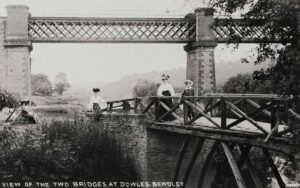
The bridge was built during 1862 and 1863 at a cost of £7,000. It was a viaduct of three openings, each of seventy feet, carried on wrought iron lattice girders resting on masonry piers and abutments. The ironwork was not made on site. It came in sections from Brassey’s Canada Works at Birkenhead, one of the great Victorian engineering shops, and was assembled here.
The first train crossed on 5 August 1864, a pleasure trip laid on for the directors and their friends. Public services began on 13 August.
The line it carried
The Wyre Forest line ran from Bewdley through Wyre Forest, Cleobury Mortimer and Neen Sollars to Tenbury Wells, joining the wider network beyond. It was never a busy railway. It served scattered villages, an orchard and hop country, and it existed largely because the Victorians built railways everywhere and worried about the traffic afterwards.
The Severn Valley line through Bewdley had opened two years earlier, in 1862, and the branch fed into it. For a town whose river trade had drained away to Stourport, the railways arrived a century too late to make Bewdley a hub again, but they did bring the first leisure visitors, and one of those two lines eventually became the reason many people come here at all. There is BBC film from 1981 of a day trip up it from Bewdley to Bridgnorth, by which time the Severn Valley was already a preserved railway rather than a working one.
Losing it
Passenger services on the Tenbury branch finished on 1 August 1962, and freight lasted only a few years beyond that. Once a line closes, a river bridge becomes a liability rather than an asset: it needs inspecting, maintaining and insuring, and it earns nothing. Dowles Bridge was demolished in March 1966.
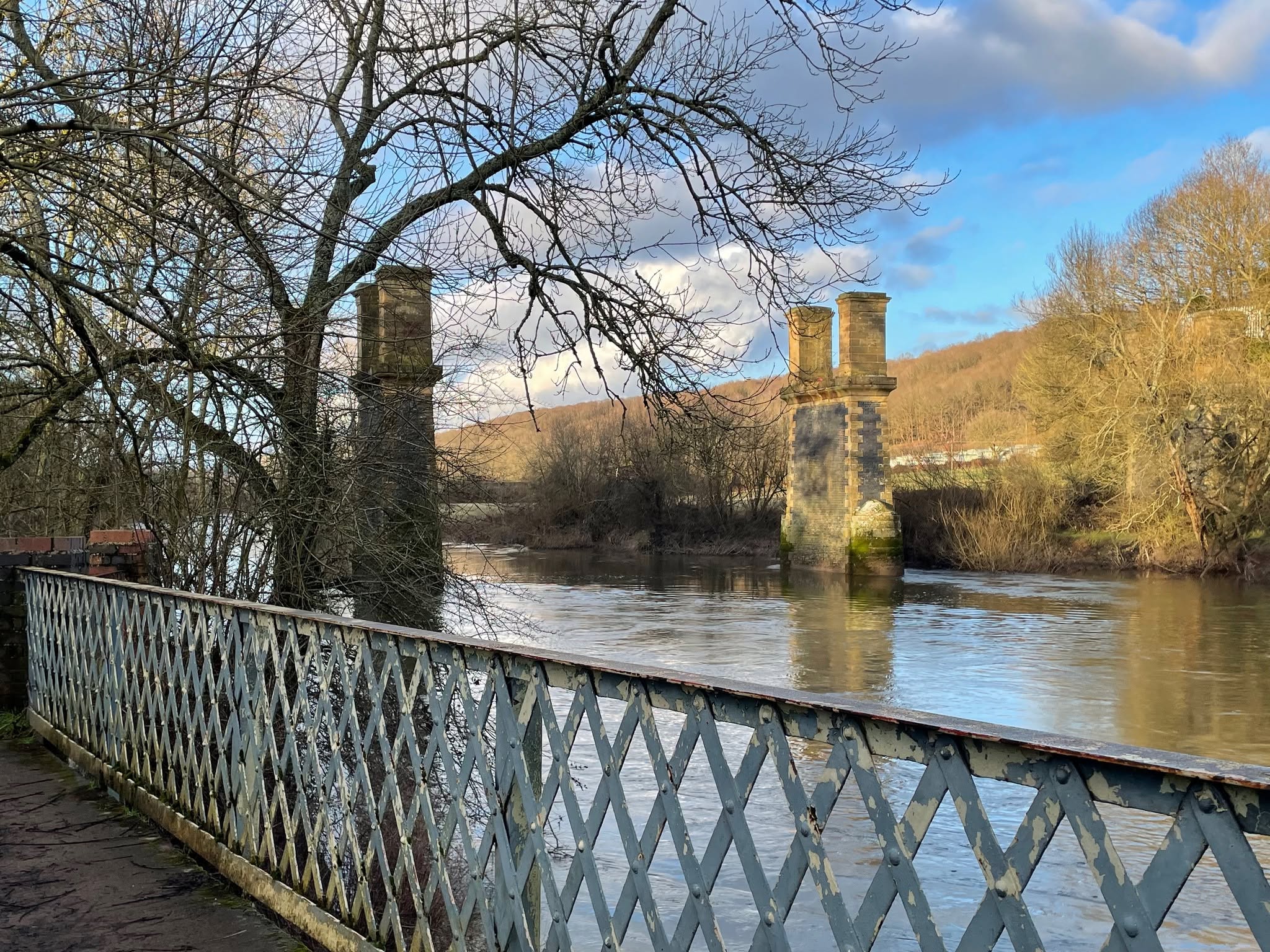
The demolition took the ironwork. It did not take the masonry, and that is why the piers are still there, standing in the water in a straight line pointing at nothing, sixty years after the last train.
Seeing it
The piers are visible from the riverside path north of Bewdley, on the walk out towards Dowles and the forest. They photograph beautifully in low light and in river mist, which is why they turn up so often in photographs of the area, usually without a caption explaining what they were.
Bewdley has a habit of this. The medieval bridge is still under the water by Severnside South, found again in 2004 when a bandstand was lifted off it. The old quarry that supplied the railway viaduct is still cut into the rock off the Kidderminster Road. The bell pits are still in the forest floor. And a mile upstream, three piers stand in the Severn holding up a railway that closed before most people now living here were born.